The Golf Ball Fitter LLC
The Ultimate Driver
V88
◉ Language Units
The Golf Ball Fitter LLC
the-ultimate-driver.com
Version 88
Long drive build optimizer

The Ultimate Driver

Build your driver for normal play or for the World’s Longest Drive contest.
01

The golfer

measure swing speed on a monitor for best results
Driver swing speed
100MPH
Attack angle+3°
Tee height
01″2″3″4″
Center of face to center of ball
Temperature70°F
Altitude0 ft
Standard conditions — sea level, 70°F.
Projected total — optimized build
YDS
Carry
YDS
Ball speed
MPH
Smash
Launch
°
Spin
RPM
Apex
FT
Descent
°
Straightest Longest
68% distance / 32% accuracy
02

Your current driver

optional — for the side-by-side comparison
What are your current driver specifications, so we can compare it to our recommended driver?
Current performance — we can estimate it, or enter your launch-monitor numbers
03

The build

your one driver, spec by spec
Ball on the tee & the effective loft

04

Our recommended driver to you

head, shaft & ball matched to this build
Picks are mapped to your fitting targets from a starter catalog of current models — swap in the exact heads, shafts and balls you stock by editing the CATALOG block in this file.
05

Why this is your longest drive

the engineering behind the number

1
Ball speed is the engine

Distance starts with ball speed — swing speed multiplied by smash factor. A centered strike and a shaft that returns the face square convert more of your speed into the ball. At driver speeds, every 1 mph of ball speed is worth roughly two yards.

2
Hitting up is free yardage

Teeing the ball high and striking up — a positive attack angle — is the only lever that raises launch and lowers spin at the same time. For most golfers it's the single biggest distance gain, and you get it without swinging any harder.

3
Launch high, spin low

Carry peaks inside a narrow launch-and-spin window. Too much spin and the ball balloons and drops; too little and it falls out of the air early. The build targets the window that's optimal for your exact speed.

4
Low spin runs out

A penetrating, low-spin flight lands at a shallower angle and rolls. So total distance keeps climbing after the ball lands — you win twice, once in the air and again on the ground.

5
The whole system points one way

Loft, length, shaft weight and flex, swing weight, spine/FLO, and the ball are all chosen together. Tune one part in isolation and you give back what you gained somewhere else; optimize them as a system and the yards stack. That's the difference between a build and a guess.

6
Researched, not guessed

The engine cross-references driver heads, shafts and balls — each profiled by launch, spin, weight and feel — to find the exact head, shaft and ball that match your numbers. Decades of fitting, distilled into the pick.

06

Remember these items to gain on your competition

open each item for the details
Launch conditions — attack angle, tee height, loft & spin

Hitting up on the ball — a positive attack angle — launches it higher with less spin, the exact recipe for carry, and it's often the single biggest distance gain available with no extra effort. Teeing the ball high, so you catch it on the upswing and strike high on the face, supports that — higher tee means higher launch and lower spin. Loft is then matched to your delivered angle so you arrive in the optimal launch-and-spin window for your speed rather than ballooning or knuckling. The build promotes all three together through loft, tee height and length.

Club length & swing weight

A longer shaft raises clubhead speed, but a wider arc is harder to center — so we lengthen only as far as your strike and priority justify; speed you can't control isn't distance. Long-drive setups run longest, a fairway-finder shorter and steadier. Swing weight — how heavy the head feels through the swing — is matched to that length and your tempo so you can square the face and time the release: too heavy bleeds speed, too light costs control.

Shaft spine / FLO alignment

Every shaft has a stiff plane. Aligning it (FLO — flat line oscillation) so the shaft flexes in one consistent plane tightens shot-to-shot dispersion. This is the straightness lever, and it's why two identical drivers can disperse differently.

Dr. Grip spinning a shaft to check spine / FLO alignment
Notice there is no shaft oscillation and the head is flexing in one plane — this means the spine is in alignment.
Build bias (distance vs. accuracy)

This is the Priority slider expressed as a percentage. At, say, 68% long the build is weighted roughly two-thirds toward maximum distance and one-third toward a tight, repeatable miss — so length, club length, attack angle and tee height are pushed harder, with the shaft and head leaning low-spin. Slide toward Straightest and the build shortens and stabilizes for a fairway-finder; slide toward Longest and it's set up to send it for a long-drive contest.

Reading the numbers

Projections are physics-based estimates for optimal contact, meant to compare builds and show what each change is worth — not a guarantee. Validate the final build on a launch monitor.

Warm golf balls fly farther than cold ones

A warm golf ball is more elastic — it compresses and rebounds off the face better, so it leaves with more ball speed and carries a little farther; a cold ball stiffens, loses rebound and comes off slower and shorter. On a cold day, keep a spare ball in your pocket and rotate to a warm one every hole or two — over a round it can be worth several yards. Note: deliberately heating a ball with a device during a round is against the Rules of Golf, but body heat in your pocket is fair game.

An extra wrap under the low hand adds control

Building up the lower-hand end of the grip with an extra wrap of tape thickens it where your trail hand sits. A larger lower-hand grip quiets excessive hand and wrist action through impact, so the face over-releases less and returns more square — more control and a tighter, more repeatable miss. The upper hand stays standard, so it’s a small change you can feel without rebuilding the whole grip.

Tipping a parallel shaft to regain stiffness

Trimming material from the tip end of a shaft — “tipping” it — stiffens the shaft and firms up a tip that’s playing too soft, trimming a touch of launch and spin. Parallel-tip shafts are built for this: the tip section is a constant diameter, so you can tip them by the maker’s chart to regain or fine-tune stiffness, and they still seat correctly in the hosel. A tapered-tip shaft is the opposite — its tip diameter shrinks continuously and it’s designed to be trimmed only from the butt. Tip a tapered shaft and the new end is too large to fit the hosel and you destroy the engineered flex profile, so it should never be tipped.

07

The results

your current driver vs. this build

Estimated from your swing and the optimized build. Enter your current head, shaft and ball above to sharpen the “your driver now” figures.

Ball flight — your driver now vs. our build Hover a flight line for the full specs

The fitter behind the build

why these numbers are worth trusting
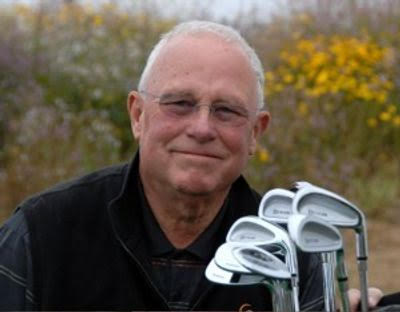
David Butler — Dr. Grip
“Dr. Grip”
Fitting since the 1970s
Dedicated to my friend
Wayne Freedman
David Butler — “Dr. Grip”
Founder, The Golf Ball Fitter LLC · Master Clubfitter

For half a century I've done one thing: make golfers longer and straighter by fitting the club to the player — not the player to the club. That work earned Miura Golf's first Featured U.S. Dealer distinction and coverage from ABC News. But it started a long way from the first tee.

I'm an engineer by training — with time at Chrysler and on a NASA Venus mission — and I've spent fifty years applying that same rigor to one problem: getting every bit of a golfer's energy into the ball and down the fairway. A driver is a system. Clubhead speed sets the ceiling, but smash factor — ball speed over club speed, up to about 1.50 — decides how much of it you keep, and launch angle against spin loft determines whether that speed carries or bleeds off as backspin. Attack angle, shaft FLO and torque, swing weight, ball compression, and the launch/spin window all have to work together; tune one in isolation and you give back somewhere else what you gained. So I fit the whole system, not one part: measure it, optimize it, waste nothing. That's what this tool does — fifty years of fitting, now run by AI.

A note on the range: the sliders run well past everyday speeds on purpose. In the men's game the official Guinness World Records stand at about 170 mph of club head speed (Seb Twaddell, 169.9 mph) and 235.1 mph of ball speed (Thomas Fliniks). In elite women's long drive the documented records reach about 191 mph of ball speed (2023 World champion Monica Lieving) from club head speeds around 120 mph (Lieving and five-time champion Phillis Meti). That's why the optimizer's scale — in both Men's and Women's modes — is built to fit everyone from junior and senior players right up to those record-setting speeds, and never run out before you do.
Sources: Guinness World Records · World Long Drive
Master Clubfitter ~50 Years Experience Miura First U.S. Featured Dealer Engineer — Chrysler / NASA National Championship Drag Racer Featured on ABC News Half Moon Bay, CA
David Butler outside The Butler Cabin — the Doctor Grip fitting studio
The Butler Cabin — the Doctor Grip fitting studio, where every build is measured, optimized and dialed in by hand.

Explore the network

more tools from Dr. Grip
?

Frequently asked questions

fitting, distance & how it works
What is The Ultimate Driver?

An online driver fitting from Dr. Grip. Enter your swing speed, attack angle and current driver, and it scores driver heads, shafts and golf balls to build your longest, most accurate driver.

Do I need a launch monitor?

A measured swing speed gives the best result, but a careful estimate works too. Every recommendation uses the same principles Dr. Grip applies in person.

How much does it cost?

The Ultimate Driver is a one-time $19.99. There is no subscription.

Can it build a driver for long-drive competition?

Yes. A dedicated long-drive mode with world-record swing-speed markers lets you optimize purely for maximum distance.

Does it work in metric units and other languages?

Yes. It works worldwide in 12 languages and in both English and metric units, showing your gains in yards or metres.

Who is Dr. Grip?

Dr. Grip is David Butler, a Professional Master Clubfitter with nearly 50 years of experience and an engineering background at Chrysler and NASA. He is Miura's first U.S. Featured Dealer.

Leave a review

tell us how your build performed